Rare Book


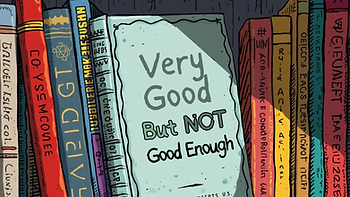
I sometimes tell myself stories from a biography of me entitled Very Good But Not Good Enough. This many-chaptered tome is filled with half-truths and lies. However, when I pull it off the shelf and let it fall open in my lap, they appear 100% accurate.
One 25-year-old chapter makes clear I am not worth a lot of effort, and purports to have been written by my grad school boyfriend. A convoluted yet boring chapter conveys the story of my being the only qualified candidate and still not getting a promotion, and a concise interstitial relays the sad tale of when I was one of two finalists for a job I really wanted, and failed to get an offer. One chapter, crafted just last year, tells the story of a man who was head-over-heels in love with me—until someone better came along.
Reading this book always makes me cry. Of course, I only pull it down from the shelf when I’m already in a crying mood. I reread it so many times in recent weeks, I fell asleep on it more than once.
(It was so much on my mind, I mentioned the book to the mother of one of my daughter’s friends when she and I met for coffee. Her eyes widened as I told her about it. She said, “I have a book like that, too. I have three graduate degrees, but I see jobs on LinkedIn and think ‘oh I’m not qualified for that.’” We smiled melancholy smiles at one another, each of us heartened to not be the only one, and each of us saddened to not be the only one.)
I know the book is full of lies, but its tropes feel so natural. In times when I drag it around with me, I project its patterns into the present. Last week, suffering from a presumed pinched nerve and the medications prescribed to address it, Very Good But Not Good Enough seemed not only true but inevitable. In the midst of that circumstance, I knew the pitch I recently sent to The Cut was DOA; it seemed clear my goals for the future were out of reach, and I should give up on them; and I was sure one of my partners had realized I’ve served my purpose in his life, and he was simply waiting to tell me.
As my physical pain lessened, I let the book drop from my hand. I looked around and realized that pitch was only a few days old and there is a path to my goals. Then I got a text from my partner that instantly disabused me of the idea he was preparing to break up with me. As I blinked away the seduction of the old and familiar version of the story of me, I asked myself, “why do you keep rereading this?”
Once I’d asked the question, I could see a different version of the story: the grad school boyfriend was a gaping hole of need. As his life partner, I would have struggled under a nearly infinite weight of emotional labor; though I applied for that promotion (and felt I should want it), I did not truly want the job; if I had gotten the position for which I was a finalist, I would be miserable now; and though I wanted the man who had been in love with me, I did not want the version of him who ended our relationship—he is better off with his current partner, and I am better off with all of mine.
I am realizing there’s another book on the shelf, just as thick as the first. It’s called Things Work Out, and it sits right next to Very Good But Not Good Enough. This new volume asks: What if my life isn’t something that happens to me? What if the moments I thought I was coming up short, Unconditional Love was actually steering me? What if, rather than being not good enough, I am worthy of the attention and intervention of forces larger than myself? Yes, God (or The Universe) shows up in Things Work Out (they are two names for the same character), not doing things to me, but helping me toward what I need and want. (They often work in ways I don’t recognize except in hindsight.)
I’m practicing reading from Things Work Out and projecting into the present its invisible hand of love. The conceit is unfamiliar, and a little uncomfortable. The stories in Very Good But Not Good Enough are well worn. They are seductive. They stroke my hair as I cry, and assure me I couldn’t have done anything differently. They wrap me in a blanket of self loathing that is comforting for its familiarity. Resisting Very Good But Not Good Enough will be an ongoing task, and reading Things Work Out will require intention. There is no automaticity for me with this new volume. Still, I prefer it. Its prose reads like verse; its insights, abundance. The subtext of every page is love, not loathing.
I only wish I had discovered it before now.


Comments